

Modern construction project management software solves critical on-site challenges in The Gambia by replacing unreliable spreadsheets and messaging apps with a single, verifiable system. A dedicated field app like Build by Carrot allows teams to capture data offline, sync it automatically when connectivity returns, and manage formal approval workflows. This creates a reliable, timestamped audit trail for all project activities, which is essential for preventing delays, managing costs, and resolving disputes.
Your Single Source of Truth: Why Spreadsheets and Messaging Apps Fail
Managing a construction project in The Gambia involves a complex web of information flowing between the site, the office, and external stakeholders. Historically, this has been managed through a disjointed patchwork of familiar but inefficient tools. Site diaries are kept in physical notebooks, critical progress photos are exchanged on WhatsApp, budget revisions live in Excel spreadsheets, and crucial approvals are pursued through convoluted email chains. This fragmented approach, while born from necessity, creates unacceptable risks. Information is easily misplaced, document versions fall out of sync, and when a dispute inevitably arises, there is no single, verifiable record of who approved what, when, and based on what information.
The core failing of this method is its inability to produce a reliable audit trail. When a client disputes a variation order's cost or a subcontractor challenges a payment certificate, the project team is forced into a frantic, time-consuming effort to piece together evidence from a dozen different places. An Excel spreadsheet can be altered with no record of the change, a WhatsApp message can be deleted, and a verbal instruction given on-site is easily forgotten or denied. This lack of a central, immutable record systemically exposes a construction business to financial losses, protracted project delays, and lasting reputational damage. It turns the critical project closeout process into a nightmare and transforms claim resolution from a factual exercise into a contest of opinions.
This is the fundamental problem that modern construction project management software, particularly platforms like Build by Carrot, is engineered to solve. It replaces the precarious collection of disparate apps and paper documents with a unified digital platform. On this platform, every single action and piece of data—from a routine daily log entry to a multi-million Dalasi change order approval—is captured, indexed, and permanently stored in one place. Instead of relying on individual memory or manually searching through endless message threads, every RFI, submittal, and drawing is interconnected, timestamped, and attributed to a specific user. This process creates a 'single source of truth' that is infinitely more reliable, searchable, and defensible than any manual or semi-digital system it replaces.
Real-Time Data Sync: Connecting the Site and the Office, Even with Unreliable Internet
A significant operational hurdle for construction sites across The Gambia, from coastal hotel projects in Bijilo to infrastructure developments further inland, is the challenge of inconsistent and unreliable internet connectivity. Site teams are tasked with capturing vast amounts of data as events unfold, but a dependency on a live internet connection means that digital tools fail the moment the signal drops. This critical failure often forces supervisors and engineers to revert to old habits: jotting notes on paper for later transcription in the site office. This two-step process reintroduces the very risks digital systems are meant to eliminate—transcription errors, data entry delays, and lost information. The promise of digital transformation feels hollow if the tools cannot adapt to the practical realities of the working environment.
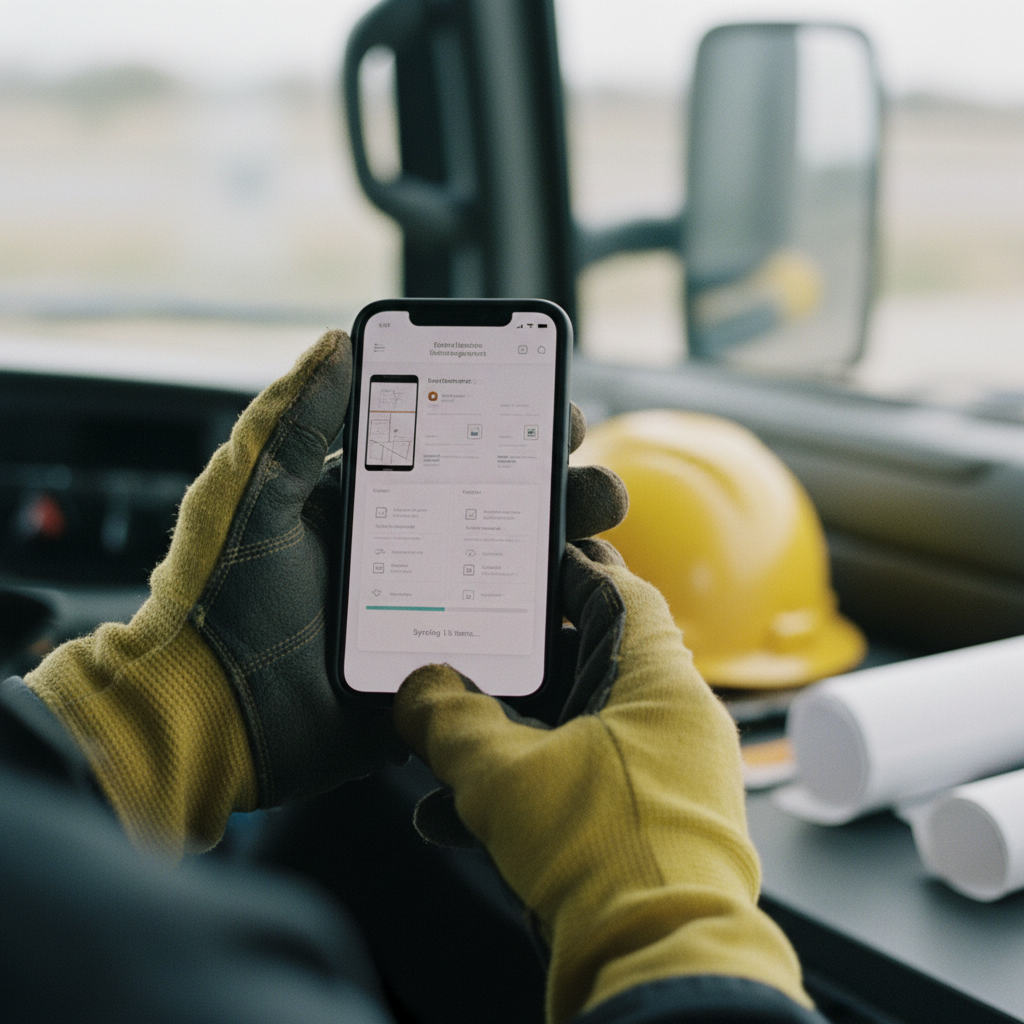
True mobile field capture is therefore entirely dependent on robust offline functionality. A well-designed construction field app must allow users to perform all their core tasks without a live internet connection. This is a non-negotiable requirement. Key offline capabilities include creating detailed daily logs, filling out comprehensive inspection forms, taking and annotating an unlimited number of photos, and raising formal Requests for Information (RFIs). The application must securely store this information on the user's mobile device and then, crucially, automatically synchronize it with the central project server as soon as a stable connection—be it Wi-Fi or mobile data—is re-established. This intelligent sync ensures no data is ever lost and that office-based teams receive timely, accurate updates from the field without demanding constant connectivity from site personnel.
Consider this practical example: a site engineer using Build by Carrot on a project in Basse Santa Su identifies a critical safety hazard. While completely offline, she can open the app, create a new safety issue, write a detailed description, attach multiple annotated photos showing the hazard, and assign it directly to the site foreman for immediate remediation. The moment she returns to an area with a mobile signal, even for a few minutes, the app detects the connection and syncs all the new data automatically. The project manager in the Banjul head office instantly sees the issue appear on their dashboard, complete with timestamped photographic evidence and a clear record of who is responsible for resolving it. This seamless, resilient flow of information is simply impossible when relying on tools that require a persistent internet connection, making offline capability the defining feature of effective site management in the region.
Structured Approval Workflows: How to End Approval Bottlenecks
Chasing approvals for decisions, materials, and changes is one of the single greatest sources of unproductive time and costly delay on any construction project. When a site engineer needs clarification on a drawing (an RFI), a subcontractor submits materials for review, or a necessary change to the project scope arises, the request often vanishes into a 'black hole' of emails, phone calls, and WhatsApp messages. It becomes exceedingly difficult to track who is responsible for the next action, how long they have had the request, and when a decision can realistically be expected. This lack of a transparent, structured process creates severe bottlenecks, stalling physical progress on site and often leading to expensive rework when teams, under pressure to move forward, proceed based on unverified assumptions.
To break this cycle, construction firms must transition from informal communication channels to structured approval workflows embedded within their project management software. Instead of sending a standalone email or making a phone call, a user initiates a formal record—such as an RFI, a material submittal, or a variation request—directly within the system. This digital record is then automatically routed to a specific, named individual or a predefined sequence of reviewers. The system provides real-time visibility into the status of the request, clearly showing whether it is 'open', 'under review', 'approved', or 'rejected'. Automated reminders and escalations can be configured to nudge reviewers who are approaching their decision deadline, introducing a layer of accountability that is absent in manual processes.
Imagine a scenario on a hotel refurbishment project in the Tourism Development Area around Kololi. The contractor identifies a need for a variation order to address unforeseen site conditions. Using a platform like Carrotsuite's Build by Carrot, the project manager creates the change order form, attaches the detailed cost breakdown from the QS, includes site photos as justification, and submits it into a pre-defined workflow. The system instantly notifies the architect for technical review. Once the architect approves, it automatically moves to the client's representative for final financial sign-off. At every stage, the project manager and all stakeholders can see the exact status and who holds the 'digital ball'. If a reviewer rejects it, their comments are captured directly on the record, providing clear, unambiguous feedback for revision. This structured process eradicates ambiguity, dramatically accelerates decision-making, and ensures every approval is meticulously documented as part of the permanent project record.
The Power of a Verifiable Audit Trail: Your Best Defence in a Dispute
In the construction industry, the ability to prove what happened is just as important as the work itself. An audit trail serves as the definitive, chronological record of a project’s entire lifecycle, and its strength is measured by its integrity and detail. A simple list of activities or a folder of documents is not an audit trail. A truly robust and defensible audit trail must be tamper-evident, meticulously recording not just what happened, but who did it, when they did it, and—critically—what the data looked like before the change. This creates an unimpeachable project memory that becomes your most valuable asset when facing a claim, query, or formal dispute, often months or even years after the event in question.
What truly separates a weak, unreliable audit trail from a strong, defensible one? A comprehensive system logs every meaningful action without exception. This includes the initial creation of any record (like an RFI or daily log), every subsequent edit (capturing both the old and new values for comparison), every change in status (e.g., a submittal moving from 'open' to 'approved with comments'), every formal approval or rejection complete with the reviewer's comments, and the attachment of any photo or document. For field-generated data, a powerful audit trail also logs both the time of data capture on-site while offline and the time of synchronization to the central server. This level of forensic detail makes the project record legally defensible and provides undeniable, objective evidence during payment negotiations, dispute resolution proceedings, or a formal financial audit.
Consider a common scenario: a payment dispute with a key subcontractor over the valuation of completed works for a specific period. Without a clear, centralized record, this quickly devolves into a messy 'he-said, she-said' argument based on conflicting spreadsheets and memories. With a comprehensive audit trail from your construction management software, the situation is resolved with facts. You can instantly produce the daily logs showing the subcontractor's labour and equipment presence on site, time-stamped photos of the completed work automatically linked to the relevant sections of the bill of quantities, and the digitally signed-off inspection form from the site supervisor confirming the quality of the installation. This wealth of evidence, captured systematically as part of the daily routine, resolves disagreements quickly, fairly, and professionally, protecting your profit margins and crucial business relationships.

From Banjul to Nigeria: Practicalities of Adopting a Nigerian SaaS Solution
For many growing businesses in The Gambia, looking to the larger, more technologically developed Nigerian market for Software-as-a-Service (SaaS) solutions is a logical and strategic step. The shared Anglophone business culture, similar operational challenges (such as infrastructure deficits), and well-established economic ties through ECOWAS make Nigerian SaaS providers an especially attractive option. When a Gambian construction firm considers a solution like Build by Carrot, which is developed by the Nigerian company Carrotsuite, there are several practical advantages and logistical points to review. The first is cross-border finance. To simplify transactions and avoid the complexity of managing exchange rate fluctuations between the Gambian Dalasi (GMD) and the Nigerian Naira (NGN), most regional SaaS providers invoice and receive payments in a stable third-party currency, almost universally the US Dollar (USD). Standard payment methods like international credit cards and wire transfers make this a straightforward process.
Support, training, and implementation are also key considerations. While the vast majority of user training and day-to-day support can be delivered effectively and efficiently online through video calls, screen sharing, and comprehensive knowledge bases, a more complex enterprise-level implementation may benefit from an in-person visit from the provider's team. The logistics for this are favourable. A direct flight from Banjul International Airport (BJL) to Murtala Muhammed Airport (LOS) in Lagos typically takes around 3-4 hours. Visa requirements are another critical checkpoint. As both The Gambia and Nigeria are members of the Economic Community of West African States (ECOWAS), protocols are in place to facilitate business travel. However, it is essential for the visiting party to verify the current visa and entry requirements for their specific nationality well in advance of any planned travel. For scheduling, planning trips during Nigeria's dry season (roughly November to May) is generally advisable to minimise potential travel disruptions caused by the heavy rains common in the wet season.
Finally, and perhaps most importantly, a Gambian company should assess the provider's intrinsic understanding of the regional business context. A software solution built from the ground up for the African market is far more likely to be designed to handle common challenges like intermittent internet connectivity, complex supply chains, and unique labour dynamics than a generic international platform developed for Europe or North America. During the evaluation process, ask the provider for specific case studies or examples of how their system has been adapted for or used by businesses across West Africa. This proven local insight, combined with adherence to global technology standards, is often the most significant advantage of partnering with a regional leader like Carrotsuite. Their deep experience in solving Nigeria's construction challenges provides a valuable and relevant blueprint for successful implementation and adoption within the Gambian market. You can explore our construction solutions further at Carrotsuite.com.ng.
Choosing the Right Software: Key Questions to Ask Before You Buy
Selecting a construction project management platform is a significant long-term investment that will fundamentally shape your company's operational workflows. To ensure you choose a system that genuinely fits your team's day-to-day reality, it is crucial to ask specific, probing operational questions that go far beyond the glossy marketing brochures and generic feature lists. A long list of features can be misleading; the real value lies in the granular details of how the software performs in the common, high-pressure scenarios that occur daily on Gambian construction sites. To make the right choice, you must focus on the core capabilities that solve your most significant and costly problems—namely, data capture in the field, approvals, and record-keeping.
Begin with a deep dive into the platform's offline functionality. Do not accept a simple "yes" to the question, "Does it work offline?" Insist on specifics and, ideally, a live demonstration. Ask clarifying questions: Can my team create new daily logs, inspections, and RFIs while completely offline, or can they only view information that was pre-downloaded? What is the conflict resolution mechanism if two users edit the same record offline before syncing? Can large files like architectural drawings and high-resolution photos be fully accessed and annotated while offline? Does synchronization happen automatically and reliably in the background, or does it require a user to manually trigger it? The answers will reveal the true usability of the app in a challenging field environment.
Next, rigorously test the approval workflows and the integrity of the audit trail. Request a live, end-to-end demonstration of a common workflow, such as an RFI being created, routed to an engineer, commented on, answered, and closed out. Then, examine the resulting audit log. Does it clearly show the 'before' and 'after' values when a critical field is edited? Does it log precisely who viewed a document and at what time? Can you easily export the complete audit trail for a single record in a human-readable format like PDF? Critically, force a discussion about the software's limitations by asking, "What common construction management tasks does your software not do?" and "What manual steps or complementary tools will we still need after implementation?" A transparent vendor will provide clear answers. Understanding a system's boundaries is just as important as understanding its strengths for making a fully informed decision.
How to Implement Construction Software for Maximum Adoption
The success of any new software is measured by its adoption. A powerful platform is useless if your team doesn’t use it. Successful implementation is not a purely technical exercise; it's a change management process that requires a strategic, human-centric approach. The primary goal is to make the transition as seamless as possible, demonstrating clear benefits to every user, from a site labourer to the managing director. The rollout should be phased, starting with a pilot project to identify and resolve challenges in a controlled environment before a company-wide deployment. This allows you to create internal champions and a set of best practices tailored to your specific operations in The Gambia.
First, define clear objectives and identify a project champion. What specific problems are you trying to solve? Are you focused on reducing RFI turnaround time, improving daily reporting consistency, or creating better cost-tracking records? These objectives will guide your implementation priorities. The project champion should be a respected member of the team, tech-savvy but also deeply familiar with your site realities. This person will serve as the bridge between the software vendor and your employees, advocating for the new system and providing practical, peer-to-peer support. Their enthusiasm and leadership are critical for overcoming initial resistance and building momentum.
Second, invest in structured, role-based training. Do not take a one-size-fits-all approach. A site supervisor needs to master daily logs and photo uploads on a mobile device, while a project manager needs to understand how to build approval workflows and generate reports in the web interface. Training should be practical and hands-on, using a real or sample project that mirrors your typical work. Follow-up sessions are essential. Schedule check-ins after one week, one month, and three months to address questions, reinforce best practices, and gather feedback. This iterative process ensures that users feel supported and that the software is configured to genuinely make their jobs easier, which is the ultimate key to achieving full adoption and a positive return on investment.
Beyond Operations: Using Project Data for Business Intelligence
Implementing construction project management software delivers immediate operational benefits by streamlining workflows and creating a single source of truth. However, the long-term, strategic value of this digital transformation lies in the data itself. Over time, your company will accumulate a vast, structured dataset covering every facet of your projects. This data is a powerful asset that can be leveraged for business intelligence (BI) to move beyond reactive problem-solving and enable proactive, data-driven decision-making. By analysing historical project data, you can uncover trends, identify hidden inefficiencies, and develop more accurate benchmarks for future bids.
One of the most valuable applications of this data is in improving the accuracy of future estimates and schedules. Instead of relying on industry averages or gut feeling, your estimators can analyse your own historical performance. For example, how long does it actually take your teams to complete a specific task, like installing blockwork or roofing, on average? By analysing thousands of daily logs, you can calculate real-world production rates. How long is the average turnaround time for an RFI with a particular architectural firm? This data helps you build more realistic timelines. Which subcontractors consistently complete their work on time and with minimal defects? This informs your procurement decisions and helps you mitigate risk by partnering with reliable performers.
Furthermore, this project data is invaluable for risk management and dispute avoidance. With a comprehensive digital record, you can analyse leading indicators of project distress. For instance, is there a correlation between an increase in safety incidents and projects that are behind schedule? Does a high volume of RFIs on a particular part of the design consistently lead to change orders and cost overruns later? By identifying these patterns, you can intervene earlier on future projects. This historical data becomes your baseline for what 'good' looks like, allowing you to spot deviations from the norm early and take corrective action before they escalate into major problems, protecting profitability and strengthening client relationships.
Frequently asked questions
What is the best construction project management software for a small business in The Gambia?
The best software for a small Gambian construction business is one that prioritises ease of use, robust offline functionality, and core features for daily reporting and approvals. Look for a platform like Carrotsuite's Build by Carrot that is designed for the African market and doesn't demand extensive IT support. Focus on solutions with predictable, transparent pricing (often per user, per month) and a mobile-first design, as your team will primarily be working from the site. The goal is to find a tool that effectively replaces your patchwork of spreadsheets and messaging apps with a reliable single source of truth.
How much does construction management software cost in The Gambia?
The cost of construction management software varies significantly. Most modern platforms available to Gambian firms operate on a Software-as-a-Service (SaaS) subscription model, typically priced per user, per month. This can range from the equivalent of $20 USD to over $100 USD per user monthly, depending on the platform's complexity and feature set. When budgeting, always ask for a detailed quote that clarifies the total cost of ownership. Be sure to check for potential extra fees for data storage above a certain limit, access to specific integrations, or premium customer support.
Can I manage site safety and inspections with this type of software?
Yes, absolutely. Managing safety and quality inspections is a core strength of modern construction software. You can digitise your existing paper forms or create new custom checklists for toolbox talks, site safety audits, quality assurance checks, and more. Field personnel can complete these forms on a mobile device, attach timestamped photos to document compliance or identify non-compliance, and instantly assign corrective actions to the responsible party. This creates an unimpeachable, time-stamped record of all safety and quality management activities, which is invaluable for demonstrating compliance and managing risk.
How does a field construction manager app handle data from remote sites with poor internet?
A well-designed field app operates on an 'offline-first' principle. This means it is engineered to allow your team to create, view, and edit all critical project information—including daily logs, photos, inspection forms, and RFIs—directly on their mobile device without needing an active internet connection. The app securely saves all changes locally. As soon as the device re-establishes a network connection (whether Wi-Fi or mobile data), it automatically and intelligently synchronizes the new data with the central server. This ensures the office always has the latest information without disrupting or hindering vital fieldwork.
Will I still need to do manual work after implementing this software?
The objective of construction software is to strategically automate and dramatically reduce manual work, not eliminate it entirely. The initial data—such as the details of a daily log, the result of an inspection, or a photo of a defect—must still be captured and entered by a person on site. The transformative benefit is that this data is entered once, at the source. This single entry eliminates the inefficient, error-prone manual labour of re-typing notes, physically chasing signatures, and manually compiling reports, thereby freeing up your skilled team members to focus on higher-value management tasks.
How can a CRM with WhatsApp help my construction business?
While construction management software optimises on-site operations, a Customer Relationship Management (CRM) system manages your client-facing activities. For a construction firm, this involves tracking leads for new projects, managing communications with prospective clients, sending proposals, and nurturing relationships with past clients to encourage repeat business. An integration with WhatsApp is particularly valuable, as it allows you to capture and centralise these informal but crucial conversations within your official client record. This ensures that promises and details discussed via chat are not lost and are part of the formal project history.
What is the difference between project management and field management software?
While related, they serve different primary functions. 'Project management' software is a broad category that often focuses on office-based tasks: overall scheduling (Gantt charts), high-level budgeting, and resource allocation. 'Field management' software, like Build by Carrot, is a specialised subset focused on connecting the job site to the office. Its strengths are mobile-first data capture, offline functionality, daily logs, photo management, and site-level communication like RFIs and inspections. For most construction contractors, a strong field management tool is the most critical first step for digitalisation.
Is my data secure on a cloud-based construction platform?
Reputable cloud-based software providers invest heavily in security measures that typically surpass what a small or medium-sized business could implement on its own. Your data is stored in secure data centres with multiple redundancies, protected by advanced encryption both in transit and at rest. Access is controlled through user permissions that you define, ensuring people only see the information relevant to their role. Always ask a potential vendor about their specific security protocols, data backup procedures, and compliance with international data protection standards.
About Carrotsuite
About Carrotsuite
Carrotsuite is an enterprise software company building intelligent business management solutions for organizations that want to operate with greater structure, visibility, and control.
Founded with a focus on solving the everyday operational challenges of growing organizations, Carrotsuite has evolved into a comprehensive business technology platform serving organizations across multiple industries. Our expertise spans Enterprise Resource Planning (ERP), Hospital Management Systems (HMS), workflow automation, financial management, HR and payroll, procurement, inventory, project management, CRM, and operational intelligence.
We serve businesses, hospitals and healthcare organizations, real estate companies, construction firms, retailers, logistics companies, churches, and other growing and enterprise organizations that need their operations connected in one system.
Our approach goes beyond simply digitizing existing processes. We help organizations replace fragmented spreadsheets, disconnected applications, manual approvals, paper-based processes, and limited visibility with structured digital workflows and centralized business intelligence.
Carrotsuite combines deep understanding of business operations with modern software engineering to build solutions that are practical, scalable, and designed for real-world organizations. Our platforms support multi-branch operations, role-based access, approvals, workflows, reporting, audit trails, integrations, and enterprise-level controls.
Our growing expertise in healthcare technology is reflected in Carrotsuite HMS, designed to support complex hospital operations across clinical, administrative, financial, laboratory, pharmacy, theatre, HMO, occupational health, and multi-branch environments.
We believe world-class software should not only look modern—it should solve serious business problems, improve accountability, and scale with the organization.
Today, Carrotsuite continues to expand its technology platform and international reach, with a long-term vision of becoming a world-class enterprise technology company serving organizations across Africa and global markets.