

Best HMS and EMR Solutions for Hospitals in Nigeria
Hospitals in Nigeria are increasingly moving from paper files, spreadsheets and disconnected departmental applications to integrated Hospital Management Systems (HMS) and Electronic Medical Record (EMR) software platforms.
The right hospital software should do more than store patient information. A modern system should connect patient registration, appointments, clinical documentation, laboratory, pharmacy, billing, inventory, inpatient care, insurance/HMO workflows, reporting and hospital administration.

There is also an important distinction between an EMR and an HMS. An EMR primarily manages the patient’s clinical record, while an HMS generally extends into the wider operational side of a hospital, including billing, pharmacy, inventory, wards, appointments and administration. In practice, many modern platforms combine both.
There is no single HMS that is perfect for every hospital. A 20-bed private hospital, a specialist centre, a maternity hospital, a large multi-branch hospital and a teaching hospital can have very different requirements.
Below are 10 HMS and EMR solutions hospitals in Nigeria can consider in 2026, followed by the key features hospitals should evaluate before making a decision.
10 HMS and EMR Solutions for Hospitals in Nigeria
1. Carrotsuite HMS
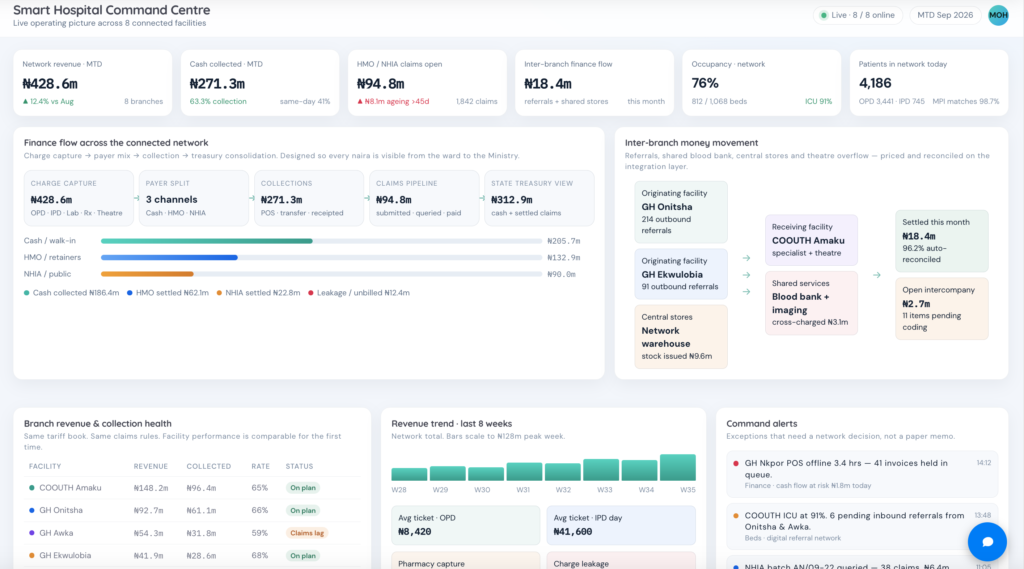
Carrotsuite HMS is a comprehensive hospital management and electronic medical records platform designed to connect clinical, administrative and financial hospital operations. Carrotsuite HMS also stands out as a full fledged healthcare ERP software that is multi
Rather than treating the EMR as a standalone patient-record application, Carrotsuite HMS is designed around the wider hospital workflow, connecting clinical departments with billing, inventory, pharmacy, laboratory, HMO management and administration.
Key Carrotsuite HMS features
- Patient registration and patient management
- Electronic Medical Records (EMR)
- Patient history and clinical documentation
- Appointments and booking
- Doctor and nursing workflows
- OPD and inpatient management
- Admission, transfer and discharge workflows
- HMO and insurance management
- HMO eligibility and plan verification
- HMO tariffs and service pricing
- Claims and payer-related workflows
- Billing and invoicing
- Payments and patient accounts
- Patient balances and financial tracking
- Pharmacy management
- Drug inventory and dispensing
- Laboratory and investigations
- Test requests, results and investigation workflows
- Radiology and imaging
- Imaging requests and reports
- Theatre/operating room management
- Surgery scheduling
- Theatre resource requests
- Surgical cases and operating lists
- Equipment, instruments, consumables and implants
- Blood bank management
- Blood products, crossmatching and blood-bank workflows
- Maternity management
- Antenatal, delivery and maternity workflows
- Specialty clinical modules
- Support for specialist departments and configurable workflows
- Inventory and procurement
- Stock management
- Requisitions
- Purchase workflows Approvals
- Finance and accounting
- Hospital financial reporting
- Revenue tracking
- Multi-branch hospital management
- Centralised visibility across locations
- Role-based access control
- Department and user permissions
- Auditability and controlled access to sensitive information
- Reports and analytics
- Clinical reports
- Administrative reports
- Financial reports
- Operational dashboards
- Patient-facing capabilities
- Patient access and communication workflows
- Workflow and approvals
- Configurable approval processes for hospital operations
One of the major advantages of an integrated HMS solution is that information does not have to be entered repeatedly by different departments. For example, a doctor’s order can trigger a laboratory, pharmacy or billing workflow rather than requiring staff to recreate the same information manually.
For hospitals evaluating Carrotsuite HMS/EMR software, the appropriate approach is to request a workflow-based demonstration using the hospital’s actual processes rather than evaluating the system purely from a feature checklist.
2. Helium Health
Helium Health is one of the established African health technology companies and offers HeliumOS, a SaaS-based electronic medical records/hospital management information system.
Its platform is aimed at digitising healthcare providers and supporting clinical and operational workflows. Helium Health says its technology is used by clinicians, governments and healthcare stakeholders across Africa.
Hospitals considering Helium should examine the exact modules available for their facility, implementation model, integrations, reporting requirements and specialty workflows.
Potential fit: Private hospitals, healthcare groups and organisations looking for an established African healthtech platform.
3. ClinikEHR
ClinikEHR is a Nigerian healthcare software platform focused on EMR and clinic/hospital operations.
Its published features include HMO and NHIS billing, pharmacy and inventory, patient portals, telehealth and optimisation for environments where internet connectivity may fluctuate.
Its public materials also highlight electronic prescribing, laboratory workflows, appointments and patient management.
Potential fit: Clinics and small-to-medium healthcare facilities looking for a Nigeria-focused EMR with operational features.
4. AjirMed
AjirMed describes itself as a connected EMR, EHR, LIMS and hospital management platform built specifically for Nigerian healthcare.
Its platform brings together patient records, clinical care, laboratory, pharmacy, billing, inventory, wards, HMO workflows and management reporting. It also promotes cloud-native deployment and local implementation support.
Its broader product offering includes patient portals, telemedicine, AI-assisted documentation and laboratory management.
Potential fit: Nigerian hospitals looking for an integrated clinical, laboratory and operational platform.
5. MocDoc
MocDoc offers cloud-based hospital, clinic and laboratory management software and has a dedicated Nigeria offering.
Its published Nigerian platform includes EMR/EHR, billing, appointments, pharmacy, laboratory, patient care, OPD/IPD workflows, HMO/insurance workflows and multi-location management.
MocDoc states that its platform is designed for both private and public healthcare providers and can support facilities ranging from smaller centres to larger hospitals.
Potential fit: Hospitals and healthcare organisations seeking a cloud-based, multi-location healthcare management platform.
6. OpenMRS
OpenMRS is different from most commercial Nigerian HMS products because it is an open-source EMR platform.
The OpenMRS community reports deployments across more than 70 countries and describes the platform as highly configurable. Its features include clinical documentation, patient registration, appointments, queues, billing, inventory, laboratory and dispensing, reporting, role-based access and interoperability through REST and FHIR APIs.
OpenMRS is particularly interesting for organisations that have technical teams or implementation partners capable of configuring and maintaining an open-source platform.
It has also been used in projects serving healthcare facilities in Nigeria.
Potential fit: NGOs, research organisations, government programmes, teaching institutions and technically capable healthcare organisations requiring a highly configurable EMR.
7. DokiTab
DokiTab positions itself as an offline EMR and hospital management platform built for African healthcare.
Its published platform includes electronic medical records, staff and scheduling management, analytics, pharmacy, diagnostics, dental and physiotherapy workflows, alongside mobile access. It also highlights offline operation, encryption, audit trails and location-based access controls.
The offline-first approach is particularly relevant to hospitals that need clinical workflows to continue when internet connectivity is interrupted.
Potential fit: Private clinics and hospitals that prioritise mobile access and offline resilience.
8. MedSync EMR
MedSync EMR describes itself as an offline-capable hospital management system for Nigerian hospitals.
Its published features include:
- Offline-first clinical workflows
- Laboratory and pharmacy management
- Inpatient ward management
- Bed occupancy
- Nursing notes
- Private and HMO billing
- HMO tariffs and claims review
- Patient wallets
- Deposits
- Split payments
- Financial reporting
- Role-specific workflows
MedSync specifically highlights automatic synchronisation after connectivity returns and workflows designed for Nigerian hospital operations.
Potential fit: Nigerian hospitals where connectivity resilience, HMO billing and financial controls are major requirements.
9. HMSi360
HMSi360 is a hospital management platform targeted at healthcare providers across Africa.
Its published modules include:
- Electronic health records
- Appointments
- Telemedicine
- Inpatient and ward management
- Pharmacy
- Laboratory
- Radiology
- Billing
- HMO/NHIA claims
- Reports and analytics
The platform also advertises HL7 FHIR interoperability, multi-currency billing and support for healthcare operations across several African countries.
Potential fit: Hospitals and healthcare groups looking for a cloud-based HMS with African regional capabilities and interoperability options.
10. RillCare
RillCare positions its platform as an AI-powered hospital management system built for Nigeria.
Its published product scope includes EMR, OPD, inpatient care, pharmacy, laboratory, theatre, ICU/HDU, dialysis, radiology, HMO/NHIS claims, mortuary management, ambulance dispatch, physiotherapy and patient portals. Its higher-level HMS offering also includes administration, HR, finance, procurement and hospital management dashboards.
The company also promotes AI-assisted clinical documentation and multilingual voice features.
Potential fit: Hospitals interested in combining conventional HMS functionality with AI-assisted clinical and administrative workflows.
What Should a Nigerian Hospital Look for in an HMS or EMR?
Choosing hospital software should not be based on the number of features displayed on a vendor’s website.
Instead, hospitals should test the software against actual workflows.
1. Complete patient journey
The system should support the patient’s journey from:
Registration → Appointment → Consultation → Investigation → Pharmacy → Billing → Admission → Treatment → Discharge → Follow-up
The less duplicate data entry required, the better.
2. Clinical EMR functionality
At minimum, evaluate:
- Patient history
- Clinical notes
- Vital signs
- Diagnoses
- Prescriptions
- Orders
- Laboratory results
- Imaging
- Allergies
- Procedures
- Discharge summaries
- Clinical reports
3. Pharmacy and inventory
A hospital should be able to connect prescriptions and dispensing with inventory.
The system should support stock levels, batches, expiry dates, stock movements, adjustments and reporting.
4. Laboratory and diagnostics
Look beyond simply having a “Lab Module.”
Test whether the system can actually manage:
Request → Sample → Processing → Result → Verification → Clinician review → Billing
5. HMO and insurance
This is particularly important for Nigerian hospitals.

The software should support different tariffs, patient plans, authorisations, claims, rejected claims, payments and reconciliation.
The National Health Insurance Authority was established under the NHIA Act 2022, which replaced the former NHIS legal framework.
6. Data protection and security
Hospital software handles highly sensitive personal and health information.
Hospitals should evaluate:
- Role-based permissions
- Audit trails
- Encryption
- Backups
- Data retention
- Access controls
- User activity logs
- Data export
- Disaster recovery
- Privacy processes
The Nigeria Data Protection Act 2023 establishes the country’s data protection framework, and the NDPC specifically highlights privacy and responsible handling of health data.
7. Reporting and management visibility
Hospital owners and administrators need more than clinical records.
A good HMS should provide visibility into:
- Revenue
- Patient volumes
- Admissions
- Bed occupancy
- Pharmacy sales
- Laboratory activity
- HMO claims
- Outstanding balances
- Expenses
- Inventory
- Department performance
8. Scalability
A hospital may start with one location and eventually have several branches.
Ask whether the software supports:
- Multiple branches
- Multiple departments
- Multiple users
- Central reporting
- Shared patient records
- Role-based access
- Configurable workflows
9. Connectivity and infrastructure
Nigeria’s infrastructure environment makes this especially important.
Ask vendors:
What happens when the internet goes down?
A hospital should understand exactly which functions continue working, whether information is cached locally and how synchronisation works when connectivity returns.
10. Implementation and support
Buying software is only the beginning.
Hospitals should evaluate:
- Data migration
- Staff training
- Configuration
- Onboarding
- Technical support
- Response times
- Updates
- Customisation
- Integration
- Post-go-live support
Why an Integrated HMS Is Better Than Separate Hospital Software
One of the biggest problems with hospital digitisation is creating several independent systems.
For example, a hospital might have:
- One application for patient registration
- Another for laboratory
- Another for pharmacy
- Excel for inventory
- Manual HMO claims
- Paper clinical notes
- Separate accounting software
The hospital may technically be “digital”, but employees still have to move information manually between systems.
An integrated HMS creates a connected operational environment.
A doctor’s prescription can feed pharmacy.
A laboratory request can generate a lab workflow.
A completed investigation can return to the patient’s record.
A bill can reflect services delivered.
An HMO claim can be generated from the underlying patient encounter.
Management can then see the resulting clinical and financial activity through reports.
That connected workflow is often more important than having the largest number of individual modules.
How to Choose the Right HMS for Your Hospital
Before signing a contract, ask every shortlisted vendor to demonstrate the same five real-life workflows.
Workflow 1: Outpatient consultation
Register a new patient → book appointment → consultation → diagnosis → prescription → laboratory request → billing.
Workflow 2: HMO patient
Register patient → verify HMO → apply tariff → consultation → investigation → pharmacy → generate claim.
Workflow 3: Inpatient admission
Admission → bed allocation → nursing → doctor rounds → medication → laboratory → billing → discharge.
Workflow 4: Surgery
Schedule surgery → obtain approval → create operating list → request resources → record procedure → account for implants/consumables → generate charges → complete case.
Workflow 5: Management reporting
Ask the vendor to show:
“How much revenue did our hospital generate this month, from which departments, and how much is outstanding from HMOs?”
This will reveal much more about the software than a 60-slide product presentation.
Final Thoughts
The best HMS or EMR for a Nigerian hospital is not necessarily the software with the longest feature list. It is the platform that can reliably support the hospital’s actual clinical, financial and administrative workflows.
Hospitals should evaluate solutions based on clinical depth, operational integration, HMO capability, security, reporting, scalability, connectivity, implementation and support.
The 10 platforms covered in this guide provide different approaches to hospital digitisation, ranging from comprehensive commercial HMS platforms to open-source EMRs and newer mobile-first systems.
For hospitals considering Carrotsuite HMS, the most useful next step is a workflow-based demonstration covering the actual departments and processes of the facility—from registration and consultation through laboratory, pharmacy, billing, HMO, inpatient care, theatre and management reporting.
Frequently Asked Questions
What is the best HMS in Nigeria?
There is no single HMS that is the right choice for every Nigerian hospital. The appropriate solution depends on the hospital’s size, specialties, number of branches, HMO requirements, clinical workflows, budget, infrastructure and implementation needs.
What is the difference between HMS and EMR?
An EMR primarily manages a patient’s electronic clinical record. An HMS generally covers the wider operation of a hospital, including clinical records, billing, pharmacy, laboratory, inventory, wards, appointments and administration. Modern platforms often combine both.
How much does hospital management software cost in Nigeria?
Pricing varies significantly depending on the number of users, hospital size, modules, deployment model, customisation, implementation and support. Hospitals should compare the five-year total cost of ownership, rather than only the initial subscription or licence fee.
Can an HMS manage HMO patients?
Yes. Many modern Nigerian HMS platforms include HMO workflows such as tariffs, eligibility, authorisation, claims and payment tracking. However, hospitals should test the exact HMO workflow during a demonstration rather than relying only on a vendor’s feature list.
Can hospital management software work when the internet goes off?
Some platforms provide offline or offline-capable functionality, while others depend heavily on an internet connection. This should be tested specifically during procurement, particularly for hospitals operating in areas with unreliable connectivity.
Is EMR enough for a hospital?
Not always. An EMR can digitise clinical records, but hospitals often need additional systems for pharmacy, laboratory, billing, inventory, HMO, inpatient care, procurement and administration. An integrated HMS/EMR can connect these functions around the same patient and encounter.
What should a hospital ask during an HMS demo?
Don’t only ask the vendor to show features. Give them real scenarios and ask them to demonstrate the complete workflow from start to finish. This makes it easier to identify gaps between a product’s advertised capabilities and what staff can actually accomplish.