

A digital gate pass system is superior to paper logbooks for Nigerian offices as it ensures compliance with the Nigeria Data Protection Act (NDPA) 2023. Unlike insecure paper logs, a digital solution like Carrotsuite Space provides encrypted data storage, automated host notifications, and the crucial, time-stamped audit trails required to prove compliance. This enhances security, improves visitor experience through features like QR code pre-registration, and automates data retention policies.
The End of the Paper Logbook Era in Nigerian Offices
For decades, the humble paper logbook has been the first point of contact for visitors entering corporate offices, residential estates, and facilities across Nigeria. It felt simple, cheap, and straightforward. A security guard hands over a pen and a book, the visitor scribbles their name, phone number, and who they are visiting, and entry is granted. However, in today’s increasingly digital world, this manual process is not just inefficient; it’s a significant compliance and security risk. At Carrotsuite, we see firsthand how modern businesses are moving beyond this outdated method, driven by the need for better security, improved visitor experiences, and crucial data protection mandates.
The introduction of Nigeria's Data Protection Act (NDPA) 2023 has fundamentally changed the game. This legislation places strict obligations on organizations (as "data controllers") regarding how they collect, process, and store personal information—including the details of every visitor who walks through your door. The casual, open-access nature of a paper logbook is a compliance nightmare under this new regime. Personal data is exposed for anyone to see, records are easily lost or damaged, and creating a reliable audit trail for data access is practically impossible. This presents a major liability for any organization that is serious about protecting its reputation and avoiding regulatory penalties.
Beyond compliance, the practical failings of paper-based systems are glaring. Handwriting can be illegible, creating useless records. Notifying a host that their guest has arrived involves a phone call, a walkie-talkie message, or simply waiting, leading to lobby congestion and a poor first impression. There is no way to pre-register guests, verify identities, or generate meaningful reports on visitor traffic. These inefficiencies add up, creating friction for visitors and administrative burdens for your front-desk and security teams. The transition to a digital solution is no longer a luxury but a core operational necessity for forward-thinking Nigerian businesses.
Comparing Digital Systems and Paper Logbooks for NDPA Compliance
When evaluating a visitor management solution, the primary consideration for Nigerian businesses must now be compliance with the NDPA 2023. The Act requires that personal data be processed securely, stored for a justifiable period, and that a record of processing activities is maintained. A direct comparison reveals the stark inadequacy of paper logbooks in meeting these standards.
| Feature | Paper Logbook | Digital Visitor Management System (VMS) |
| — | — | — |
| Data Privacy | Exposed on open page | Encrypted, access-controlled |
| Audit Trail | None; impossible to track access | Automatic, time-stamped logs |
| Data Accuracy | Prone to illegible entries | Verified, consistent data entry |
| Host Notification | Manual (phone, radio) | Instant, automated (SMS, email) |
| Pre-registration | Not possible | Standard feature (QR codes) |
| Data Retention Policy | Manual, unreliable disposal | Automated, policy-based deletion |
| Reporting & Analytics | Manual counting, difficult | Real-time dashboards, exports |
| Compliance Evidence | Weak, difficult to produce | Strong, easily auditable |
Paper logbooks inherently fail the "privacy by design" principle. Anyone standing at the reception desk can glance over and see the names, phone numbers, and company details of previous visitors—a clear data breach waiting to happen. A digital visitor management system for offices in Nigeria like Carrotsuite Space, on the other hand, captures this information securely. Each entry is stored in an encrypted database, accessible only to authorized personnel. This fundamental architectural difference is the starting point for building a compliant visitor process.
Furthermore, the NDPA mandates that data subjects have rights, including the right to know what information is stored about them. Fulfilling such a request with a paper system means manually sifting through potentially dozens of worn, disorganized books. With a digital system, a simple search query can retrieve a visitor’s entire history in seconds. This ability to efficiently manage and control visitor data is not just a convenience; it’s a legal requirement that paper-based methods simply cannot fulfill.
The Critical Role of Audit Trails and Access Logs
An audit trail is a chronological record of the "who, what, when, and where" of any action or event within a system. Under the NDPA, maintaining a "record of processing activities" is a core obligation for data controllers. For visitor management, this means you must be able to demonstrate exactly who accessed visitor data and when. This is where paper systems completely break down. There is no way to know who has flipped through the pages of a logbook, photographed a page, or copied down personal information. This lack of traceability makes it impossible to investigate a data breach or prove compliance to auditors from the Nigeria Data Protection Commission (NDPC).
A digital visitor management system is built around creating immutable, time-stamped logs for every critical action. When a receptionist checks a visitor in, that action is logged with their user ID and a timestamp. When an administrator exports a visitor report, that event is recorded. If a security manager searches for a specific visitor’s record, that too is logged. This creates a comprehensive audit trail that serves as powerful evidence of your organization's commitment to data security and regulatory compliance. It allows you to answer with certainty who has accessed sensitive data, helping to pinpoint the source of a breach or malpractice.
The practical security benefits of these logs are immense. Imagine a security incident occurs on your premises. With a digital system, you can instantly pull a verifiable list of every non-employee who was in the building at that specific time, including their photo and the host they visited. This is invaluable for internal investigations and for providing accurate information to law enforcement. A smudged, incomplete paper logbook offers little more than guesswork in such a critical scenario. The access logs provided by platforms like Carrotsuite Space transform your front desk from a passive entry point into an active part of your security infrastructure.

Automating Host Notifications and Improving Workplace Efficiency
Beyond compliance, the operational advantages of a digital system significantly enhance the daily experience for both employees and visitors. One of the most immediate improvements comes from automating host notifications. In a traditional setup, the arrival of a guest triggers a clunky, manual process. The security or reception staff must stop what they are doing, look up the host’s extension or mobile number, and place a call. If the host doesn’t answer, the cycle of waiting and calling begins, leaving the visitor stranded in the lobby and disrupting front-desk operations.
A modern visitor management system eliminates this bottleneck entirely. As soon as a guest is checked in—either by scanning a pre-registration QR code or by entering their details on a tablet—the system automatically notifies the host. This notification is typically delivered instantly via multiple channels, such as email, SMS, or a workplace chat integration like Slack or Microsoft Teams. The host receives all the necessary information, including the visitor's name and photo, and can come to the reception to greet them promptly. This simple automation creates a seamless, professional welcome experience that reflects well on your entire organization.
This efficiency gain has a ripple effect throughout the workplace. It frees up your front-desk staff to focus on higher-value tasks rather than acting as dispatchers. It reduces lobby congestion, creating a more secure and pleasant environment. For large corporate campuses or multi-tenant buildings, this automation is not just a nice-to-have; it’s essential for managing the flow of hundreds of daily visitors without chaos. By digitizing this single, critical touchpoint, solutions like Carrotsuite Space deliver a measurable return on investment through saved time and improved operational smoothness, ensuring your visitors feel expected and valued from the moment they arrive.
Pre-Registration, QR Codes, and Creating a Touchless Visitor Experience
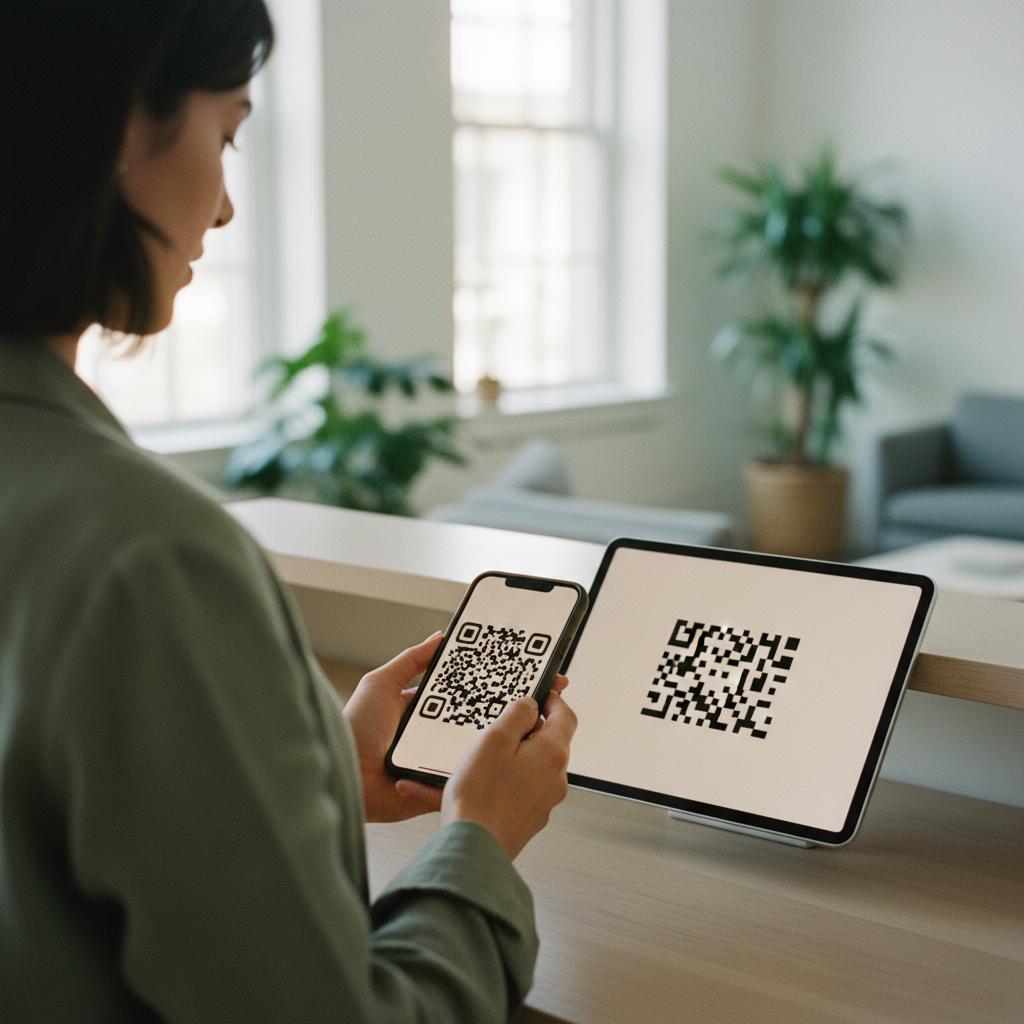
The ability to pre-register visitors is a transformative feature that paper logbooks simply cannot offer. This process allows hosts to invite guests in advance by entering their details into the visitor management system. Once registered, the system sends an invitation to the guest, often including a unique QR code, directions to the office, and any necessary entry instructions (e.g., parking information, COVID-19 protocols). This single step shifts the entire check-in process from being reactive to proactive.
Upon arrival, the visitor doesn't need to crowd around a reception desk or handle a shared pen and book. They simply present their QR code to a scanner or tablet. The system instantly verifies their identity, retrieves their details, and checks them in. The host is notified automatically, and if required, a visitor badge can be printed on the spot. This creates a fast, secure, and entirely touchless check-in experience—a crucial consideration for health and safety in a post-pandemic world. It significantly reduces wait times, making a powerful first impression of efficiency and professionalism.
The security benefits of pre-registration are substantial. It provides your security team with a forward-looking view of who is expected on-site each day, moving away from a purely reactive security posture. You can vet visitors in advance and ensure they are scheduled to meet with a verified employee. This helps prevent unsolicited walk-ins and adds a robust layer of access control. For facilities with high-security zones, pre-registration workflows can be configured to include the signing of non-disclosure agreements (NDAs) or safety waivers digitally before the visit, ensuring all compliance prerequisites are met before the guest even sets foot on the premises.
Data Retention Policies and Secure Offboarding of Visitor Information
A key principle of the NDPA and other global data protection laws is "storage limitation." This means you should not keep personal data for longer than is necessary for the purpose for which it was collected. For visitor data, this purpose is typically tied to security, safety, and short-term operational logging. Once this period expires, the data should be securely and permanently deleted. With paper logbooks, this becomes a monumental, if not impossible, task. The books are often stored indefinitely in dusty back rooms, creating a growing reservoir of unmanaged personal data and increasing your organization's risk profile over time. Deciding when and how to securely destroy these books is a manual, error-prone process that is rarely followed consistently.
A digital visitor management system automates this critical compliance requirement. An administrator can configure a data retention policy directly within the system—for example, "automatically delete all visitor records 90 days after their visit." Once set, the system takes care of the rest. It will automatically and permanently purge records that have passed their expiry date, ensuring your database remains clean and your data storage footprint is minimized. This "set it and forget it" approach provides peace of mind and demonstrable proof that you are adhering to data minimization principles.
This automated offboarding of data is a crucial part of the data lifecycle management that regulators expect. In the event of an audit by the NDPC, you can easily show your documented retention policy and the system logs that prove its automated enforcement. This stands in stark contrast to a manual system, where you would struggle to prove that records have been consistently and securely destroyed. By using a platform like Carrotsuite Space, you not only solve the problem of visitor check-in but also address the entire lifecycle of visitor data, from secure collection to automated, compliant deletion.
Making the Switch: Implementation and Total Cost of Ownership
Migrating from a paper logbook to a digital visitor management system is a straightforward process that delivers immediate benefits. Many Nigerian business owners worry about the cost and complexity, but modern SaaS solutions are designed for rapid, simple deployment. The primary hardware required is often just a standard tablet (like an iPad or Android device) for the reception desk. The software itself, being cloud-based, requires no on-site servers or complex installation. Your team can be up and running in a matter of hours, not weeks.
At Carrotsuite, we understand the importance of a smooth transition. Our implementation process is designed to be seamless, with support for data import and staff training. We often find that front-desk and security personnel adapt very quickly to the intuitive, user-friendly interface. The typical setup involves configuring your company branding, setting up user accounts for employees, defining your data retention policy, and customizing the check-in fields to match your specific security requirements. The entire process is managed through a simple web-based dashboard.
When considering the total cost of ownership, it’s crucial to look beyond the subscription fee. A digital system eliminates recurring costs associated with paper logbooks, pens, and storage. More importantly, it drastically reduces the administrative overhead on your staff, freeing up valuable time. The compliance benefits are also a major factor; the cost of a single data breach fine under the NDPA could easily exceed the cost of a visitor management system for several years. By investing in a compliant digital solution, you are not just buying software; you are acquiring a robust security tool, an efficiency booster, and a critical piece of your data protection strategy.
About Carrotsuite
Carrotsuite is a US-based global business technology and SaaS company with strong Nigerian and African roots, building world-class digital solutions for organizations across international markets. Our growing portfolio spans enterprise ERP, healthcare and hospital management, construction, retail, CRM, workplace management, and workflow automation. With a US corporate presence and deep operational expertise in Africa, Carrotsuite combines global technology standards with local market insight to deliver connected, intelligent, and scalable systems built for organizations worldwide. We are best at delivering powerful, localized software that solves real-world operational challenges for businesses in Africa and beyond.
Frequently asked questions
What is a visitor management system?
A visitor management system (VMS) is a digital solution that automates and secures the process of registering, tracking, and managing visitors to a facility. It replaces outdated paper logbooks with a tablet-based check-in, enabling visitor pre-registration, instant host notifications, photo capture, and badge printing. For Nigerian companies, a key benefit is creating the digital audit trails and access controls required for compliance with the NDPA 2023, significantly enhancing both security and data protection.
How does a digital gate pass system help with NDPA compliance in Nigeria?
A digital system directly addresses NDPA requirements in ways a paper logbook cannot. It ensures data privacy by storing visitor information in an encrypted, access-controlled database, not on an open page. It automatically creates a time-stamped audit trail of all data access, fulfilling the requirement for a record of processing activities. Furthermore, platforms like Carrotsuite Space allow you to enforce automated data retention policies to ensure information is deleted after a specified period, adhering to the principle of storage limitation.
Is a visitor management system expensive for a small business in Lagos?
Not at all. Modern SaaS-based visitor management systems are highly affordable, with pricing typically based on a monthly or annual subscription. The total cost is often much lower than the hidden costs of paper systems, which include staff time, supplies, and the significant financial risk of a data breach fine. Cloud-based solutions eliminate the need for expensive servers or IT overhead, requiring only a standard tablet. It's an accessible investment for SMEs in Lagos and across Nigeria seeking to improve security and compliance.
Can we pre-register guests before they arrive?
Yes, pre-registration is a core feature of modern visitor management systems. Hosts can enter their guest's details into the system ahead of the visit. The system then sends the guest an invitation with a unique QR code. Upon arrival, the guest scans the code for a fast, touchless check-in. This not only improves efficiency and the visitor experience but also enhances security by giving your team a clear schedule of expected visitors for the day.
What hardware do I need to set up a VMS?
The hardware requirements are minimal and readily available. The most common setup involves a tablet (such as an Apple iPad or an Android tablet) placed on a stand at your reception desk. This serves as the self-service check-in kiosk for visitors. Some organizations may also choose to connect a small label printer for printing visitor badges. The core software is cloud-based, so there is no need for expensive on-site servers or IT infrastructure.
How long does visitor data need to be stored under the NDPA?
The NDPA 2023 follows the principle of "storage limitation," meaning you should only keep personal data for as long as is necessary for the purpose it was collected. For visitor logs, this purpose is typically security and operational record-keeping. While the Act does not specify a fixed duration, a common best practice is between 30 to 180 days. Using a system like Carrotsuite Space allows you to define this policy (e.g., 90 days) and automates the secure deletion of data thereafter.
About Carrotsuite
About Carrotsuite
Carrotsuite is an enterprise software company building intelligent business management solutions for organizations that want to operate with greater structure, visibility, and control.
Founded with a focus on solving the everyday operational challenges of growing organizations, Carrotsuite has evolved into a comprehensive business technology platform serving organizations across multiple industries. Our expertise spans Enterprise Resource Planning (ERP), Hospital Management Systems (HMS), workflow automation, financial management, HR and payroll, procurement, inventory, project management, CRM, and operational intelligence.
We serve businesses, hospitals and healthcare organizations, real estate companies, construction firms, retailers, logistics companies, churches, and other growing and enterprise organizations that need their operations connected in one system.
Our approach goes beyond simply digitizing existing processes. We help organizations replace fragmented spreadsheets, disconnected applications, manual approvals, paper-based processes, and limited visibility with structured digital workflows and centralized business intelligence.
Carrotsuite combines deep understanding of business operations with modern software engineering to build solutions that are practical, scalable, and designed for real-world organizations. Our platforms support multi-branch operations, role-based access, approvals, workflows, reporting, audit trails, integrations, and enterprise-level controls.
Our growing expertise in healthcare technology is reflected in Carrotsuite HMS, designed to support complex hospital operations across clinical, administrative, financial, laboratory, pharmacy, theatre, HMO, occupational health, and multi-branch environments.
We believe world-class software should not only look modern—it should solve serious business problems, improve accountability, and scale with the organization.
Today, Carrotsuite continues to expand its technology platform and international reach, with a long-term vision of becoming a world-class enterprise technology company serving organizations across Africa and global markets.